 Local News
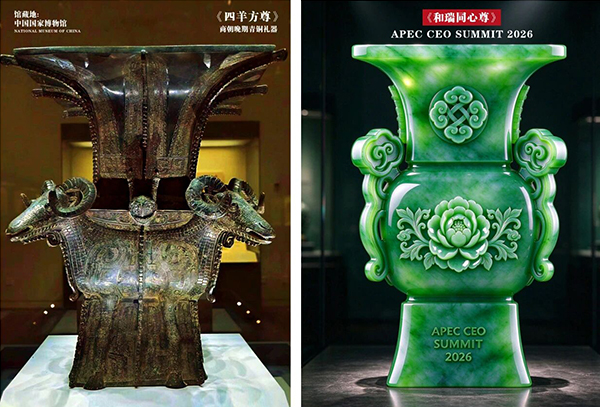
The He Rui Tong Xin Zun draws inspiration from the Shang Dynasty bronze ritual vessel Four-Ram Zun.
At a ceremony on Nov. 18 marking the transfer of hosting rights for the 2027 APEC CEO Summit, the China Council for the Promotion of International Trade presented the Vietnam Chamber of Commerce and Industry with a ceremonial vessel designed by a team from Shenzhen Technology University (SZTU) in Pingshan District.
Named He Rui Tong Xin Zun, or “Vessel of Harmony, Auspiciousness and Shared Purpose,” the piece embodies the idea of “harmony drawing hearts together, auspiciousness opening the door to shared success.” “Harmony” evokes friendship and mutual understanding, while “auspiciousness” conveys good fortune and the promise of a new chapter of win-win cooperation.
The vessel’s form draws inspiration from the Shang Dynasty bronze ritual vessel Four-Ram Zun, and it is adorned with peony, lotus, and ruyi motifs. The design combines the dignified elegance of ancient ceremonial vessels with a message of friendship across mountains and seas, expressing the vision of APEC economies coming together in harmony and working toward shared prosperity.
Its square, stately form suggests peace and stability, reflecting sincerity and steadiness in business. Relief carvings of peonies and branches symbolize enduring prosperity. The 21 peony petals on the vessel represent APEC’s 21 economies and their shared commitment to unity and prosperity.
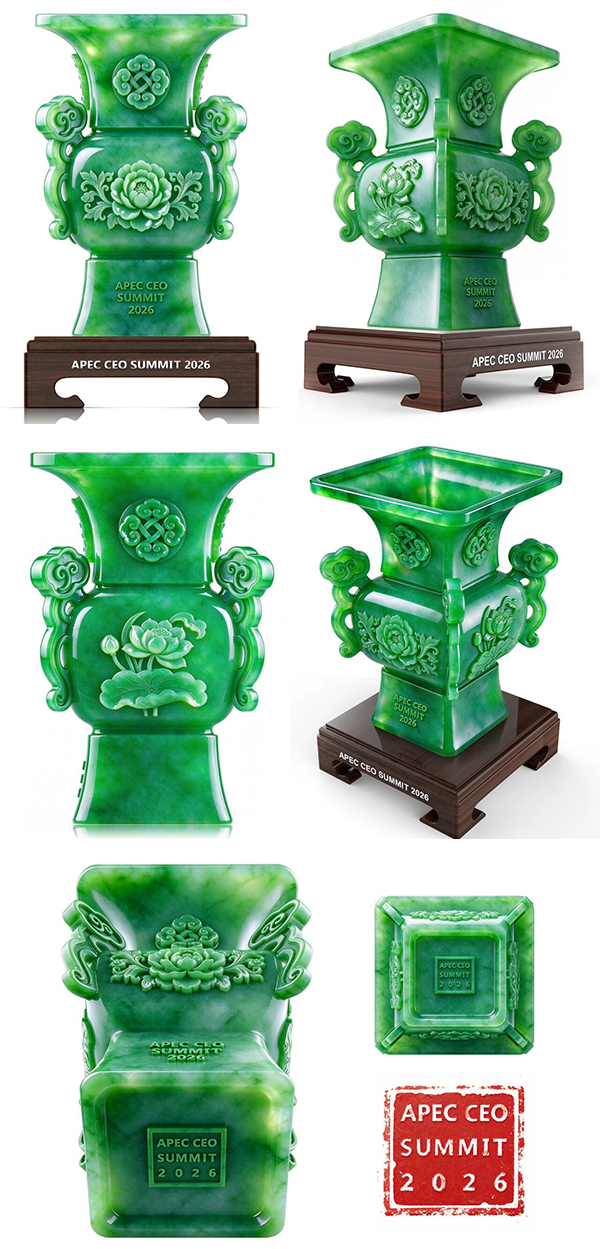
The He Rui Tong Xin Zun.
The lotuses and curling branches draw on traditional motifs associated with harmony, wealth and lasting good fortune. The lotus, admired for its purity and elegance, represents good-neighborly friendship and the enduring bond between China and Vietnam. Paired with the peonies, the motif also conveys the idea of different civilizations coexisting in harmony.
Interlocking ruyi patterns around the vessel’s neck suggest the close ties among APEC economies, as well as wishes for good fortune, friendship and lasting prosperity.
Four auspicious-beast motifs on the vessel are inspired by the suanni, one of the 10 mythical beasts associated with the roof ridges of the Hall of Supreme Harmony in Beijing’s Forbidden City. Simplified and refined, the motifs retain their auspicious symbolism and convey unity and win-win cooperation among APEC partners.
The upper-middle section of the vessel’s body is hollowed out to reduce its weight and improve its stability, allowing it to stand securely during the handover ceremony.
The base is inspired by traditional Chinese seals and bears the inscription “APEC CEO SUMMIT 2026.” In Chinese culture, a seal signifies trust and serves as a tangible mark of a promise or agreement. Here, it represents APEC economies’ commitment to consensus, sincerity and long-term cooperation founded on good faith.
The vessel is 27 centimeters tall and stands on a 6-centimeter rosewood base carved with dragon-and-scroll patterns, bringing its total height to 33 centimeters. The height references the 33rd APEC Economic Leaders’ Meeting being held in Shenzhen.
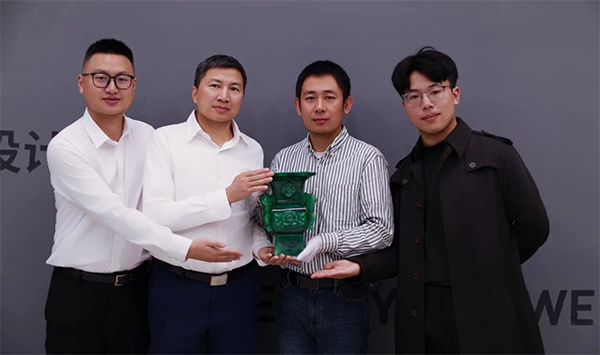
The designing team from Shenzhen Technology University.
The vessel was designed by SZTU faculty members Li Liquan and Huang Zisong, alongside graduates Dong Jiahui and Li Sidi. Guided by APEC’s vision of “building an Asia-Pacific community to prosper together” and adopting “To Prosper and Win the Future Together” as the design theme, the team spent more than seven months developing the design, producing over 130 proposals.
The team’s inspiration came from Gefeng Mountain in Guangdong, whose lush peaks and surrounding landscape provided the initial creative motif. The concept of “mountains and sea in harmony, hearts as one” informed the design from the first draft to the final version.
The designers also sought inspiration by centering on the core values of openness, innovation and cooperation while grounding the work in Chinese cultural identity. They later studied dozens of classical Chinese objects, drawing on their meanings to shape the design and its narrative.
For Li Liquan, understanding the depth of one’s roots and the essence of one’s cultural identity makes it possible to stay true to one’s foundations amid changing times. Following this approach, the team worked with objects, patterns and moods, seeking to give ancient cultural motifs new life in a contemporary context and present Chinese heritage through a design language that audiences can feel and understand.
The team’s seven-month effort was not only an exercise in designing a ceremonial gift, but also an attempt to translate Chinese cultural heritage into contemporary design and respond to the needs of the times through professional practice.

ICP Registration Number: 粤ICP备17054870号-1
 Police Registration Number:44031002000124
Website ID: 4403910001
Government Service Hotline: 0755-12345
Website Technical Support:zwxx@szpsq.gov.cn
Sponsored by: General Office of CPC Pingshan District Committee (General Office of Pingshan District People's Government, Foreign Affairs Office of Pingshan District, and Archives Administration of Pingshan District)


 HOME
 PINGSHAN GOVERNMENT
 NEWS
 ABOUT PINGSHAN
 INVEST IN PINGSHAN
 LIFE
 SERVICES
 FAQ
 CHINESE
 FRANÇAIS
 日本語
 한국어