 Local News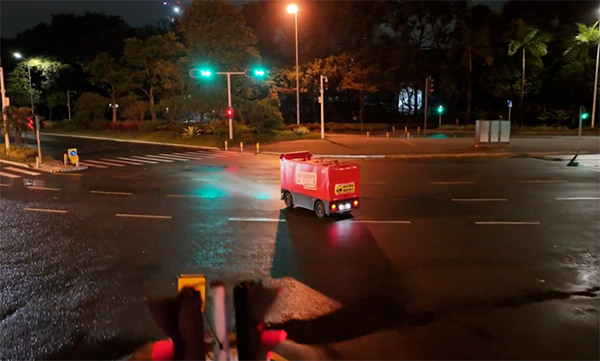
An unmanned logistic vehicle runs in Shenzhen at night. Photo from Shenzhen Special Zone Daily
An autonomous delivery vehicle loaded with consumer goods sets off from Pingshan District in the early morning, bound for Longgang District. Along the way, it stops at several logistics hubs for loading and unloading. The round trip covers more than 50 kilometers and takes about four hours.
Since March, when Shenzhen first allowed nighttime road access for functional unmanned vehicles, the operation has become routine. In just three months, the city’s nighttime delivery routes have grown from two to 331, with more than 100 vehicles deployed. In June alone, nighttime mileage topped 40,000 kilometers, signaling that autonomous night delivery is quickly becoming a standard practice.
The network is anchored by two pilot zones — Pingshan and Longgang — together accounting for over 35,000 kilometers of nighttime mileage in June. Cross-district routes now connect Bao’an, Longgang, and Pingshan, with services gradually extending to Futian, Nanshan, Longhua, Guangming, and Luohu.
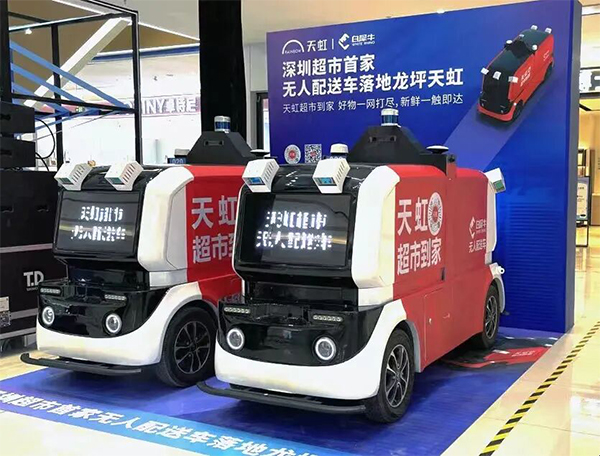
Unmanned delivery vehicles at the Rainbow Department Store’s Longping store in Pingshan District. Photo from Pingshan Media Center
The model delivers a key urban governance advantage: by moving logistics to nighttime, it frees up daytime road capacity for commuters while making use of underutilized nighttime roads.
Industrial clustering is also accelerating. Major players including Meituan, Neolix, Zelos, and JD Logistics have established operations in Pingshan. Their services cover express delivery, warehouse replenishment, and fresh produce distribution.
JD Logistics focuses on cross-district warehouse transfers and replenishment, using more than 100 night routes in Pingshan and Longgang. Neolix has deployed 51 delivery vehicles across Pingshan and surrounding areas, reporting a 30%-50% reduction in last-mile delivery costs and about a 30% improvement in efficiency.
To ensure safety as the industry scales, Shenzhen has introduced a pioneering management framework: the city’s trial rules for nighttime operations of functional unmanned vehicles.
The regulations make safety responsibilities traceable and enforceable throughout the process, while also setting low-noise requirements, reflective markings for visibility, and compliant lighting systems to reduce light pollution. They also require an emergency response mechanism, including online response within five minutes and on-site arrival within 15 minutes.
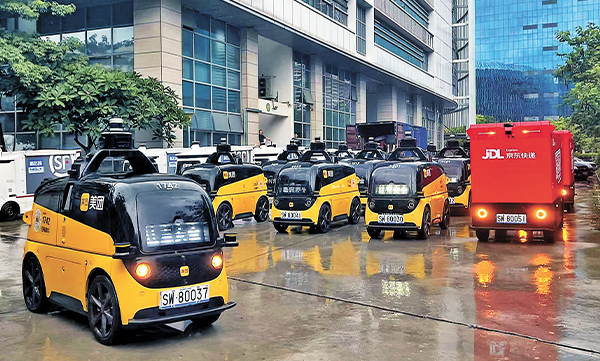
Unmanned logistic vehicles are tested in Pingshan District on June 17, 2025. Photo by Dong Yuhan
Shenzhen is a front-runner in the intelligent connected vehicle sector. As of May, the city had 1,273 functional unmanned vehicles in operation, including 815 unmanned delivery vehicles, 453 unmanned sanitation vehicles, and five unmanned patrol vehicles. The total length of 2,633 approved unmanned logistics routes reached 11,980 kilometers.
On July 1, two major policy updates — one at the national level and one from Shenzhen — took effect, expanding pilot areas and commercial operations.
In Pingshan, the concept is evolving into a “scenario forest” rather than just an industrial hub. The district has built a citywide operating system and is fostering what industry observers call a “goose flock effect,” with leading companies helping form a complete ecosystem that includes smaller partners and diverse real-world applications.
Looking ahead, Pingshan will strengthen the “scenarios-policies-standards” framework and integrate unmanned delivery with the low-altitude economy and smart city initiatives — reinforcing its role as a core engine for Shenzhen’s autonomous logistics ambitions.

ICP Registration Number: 粤ICP备17054870号-1
 Police Registration Number:44031002000124
Website ID: 4403910001
Police Registration Number:44031002000124
Website ID: 4403910001
Government Service Hotline: 0755-12345
Website Technical Support:zwxx@szpsq.gov.cn
Sponsored by: General Office of CPC Pingshan District Committee (General Office of Pingshan District People's Government, Foreign Affairs Office of Pingshan District, and Archives Administration of Pingshan District)



 HOME
HOME PINGSHAN GOVERNMENT
 NEWS
NEWS ABOUT PINGSHAN
 INVEST IN PINGSHAN
 LIFE
LIFE SERVICES
 FAQ
FAQ CHINESE
 FRANÇAIS
 日本語
日本語 한국어
한국어