 Local News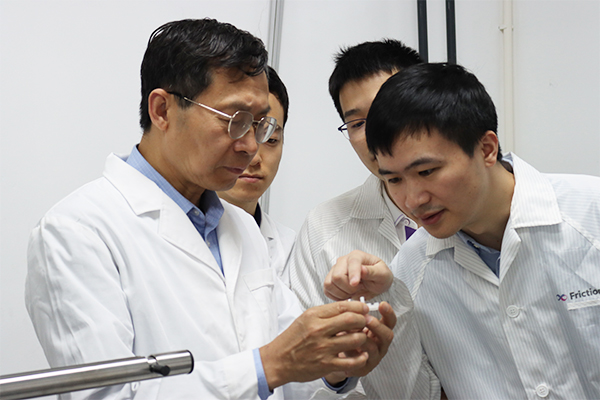
Zheng Quanshui (L) and his team members.
Shenzhen FrictionX Co. Ltd., founded by Chinese Academy of Sciences academician and Tsinghua University professor Zheng Quanshui, has unveiled its self-developed monitoring system that enables real-time, battery-free tracking of every individual item throughout its journey, supporting digitalization of logistics and airport operations.
The system uses self-superlubricity micro-generators to harvest energy from vibrations during transit. It transmits cargo data every 1.5 to 2 seconds without batteries, supporting long-term, maintenance-free operation and issuing automatic alerts for anomalies.
CTO Huang Xuanyu said all testing was completed in Pingshan, praising Shenzhen’s innovation ecosystem — covering capital, R&D spaces, technical support, and government coordination — for lowering startup risks and accelerating commercialization.
The system was unveiled at a salon held in Pingshan District on June 26. The event attracted 20 logistics companies, including Shenzhen Airport, SF Express, JD Logistics, ZTO, YTO, and CIMC, as well as major investment firms. Several companies expressed interest in pilot collaborations. Zhang Chengbao from YTO Express said the technology could significantly improve logistics operations if further developed into a full-chain management solution.
Zheng’s team has spent more than 20 years researching superlubricity. Since establishing a dedicated institute in Pingshan in 2019 and launching the company in 2021, what was expected to be a decade-long R&D journey has been shortened to just five years. FrictionX has built four engineering prototypes, secured small-batch orders, grown to nearly 160 employees, and filed 230 patents — turning the “zero-friction” theory into scalable productivity.
The company’s “superlubricity + X” innovation model has produced breakthroughs across fields including humanoid robotics, 6G communications, ambient IoT, and precision transmission.
Zheng thanked Pingshan for its support, saying: “We hope to build a vast industrial ecosystem starting from here,” and called on more supply-chain partners to set up operations near the company.

ICP Registration Number: 粤ICP备17054870号-1
 Police Registration Number:44031002000124
Website ID: 4403910001
Police Registration Number:44031002000124
Website ID: 4403910001
Government Service Hotline: 0755-12345
Website Technical Support:zwxx@szpsq.gov.cn
Sponsored by: General Office of CPC Pingshan District Committee (General Office of Pingshan District People's Government, Foreign Affairs Office of Pingshan District, and Archives Administration of Pingshan District)



 HOME
HOME PINGSHAN GOVERNMENT
 NEWS
NEWS ABOUT PINGSHAN
 INVEST IN PINGSHAN
 LIFE
LIFE SERVICES
 FAQ
FAQ CHINESE
 FRANÇAIS
 日本語
日本語 한국어
한국어