 Local News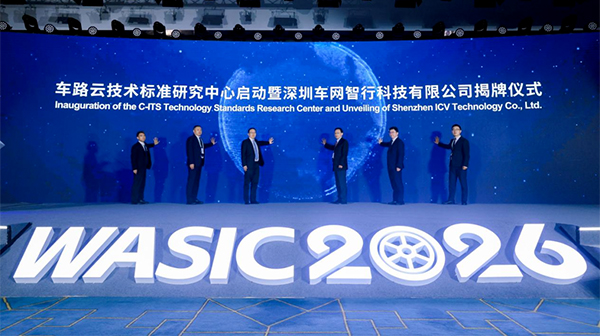
The Pingshan Vehicle-Road-Cloud Technology Standards Research Center and Shenzhen ICV Technology Co., Ltd. were unveiled during the 2026 World Automobile Standards and Innovation Conference (WASIC) held in Pingshan District from May 27 to 29. Photo from Development and Reform Bureau of Pingshan District
The 2026 World Automobile Standards and Innovation Conference (WASIC) took place in Pingshan District from May 27 to 29. The event brought together nine international and regional organizations — including the United Nations Economic Commission for Europe (UNECE) and the World Intellectual Property Organization (WIPO) — alongside delegates from 14 countries, such as Germany, Canada, Thailand, Kenya, and Uzbekistan, to foster global consensus on automotive standards and strengthen international cooperation.
The opening ceremony saw the official inauguration of the Pingshan Vehicle-Road-Cloud Technology Standards Research Center and Shenzhen ICV Technology Co., Ltd. As Shenzhen’s first professional research platform dedicated to vehicle-road-cloud integration standards, the center leverages Pingshan’s 440 kilometers of open roads for intelligent connected vehicles (ICVs) and the district’s specialized land-air testing base.
Since its trial operation began in June 2025, the center has provided data infrastructure, validation environments, and standards development support to key partners, including Tsinghua University, BYD, and the China Automotive Technology and Research Center (CATARC).
A major highlight of the conference was the release of 27 national electric vehicle standards in foreign-language editions. Covering critical areas such as post-crash safety, traction battery safety, charging interfaces, and battery recycling, this initiative is set to promote the global alignment of Chinese automotive standards.
Furthermore, the conference launched the Global Vulnerable Road User Protection Initiative and established a consensus on standardization pathways for emerging fields, including AI, the Human-Vehicle-Home Ecosystem, and advanced battery technology.
The conference served as a platform for deeper international collaboration through various talks and seminars. Notably, the CATARC signed the Automotive Standardization Initiative for the U.N. Sustainable Development Goals with the Institute of Standards of Cambodia and finalized a Memorandum of Understanding with the Ghana Standards Authority.
As a core hub in Shenzhen’s pursuit of becoming a “world-class automotive city” and a pilot zone for vehicle-road-cloud-network-map infrastructure, Pingshan has cultivated a comprehensive, full-chain ecosystem encompassing testing, manufacturing, and technical support. This robust environment serves as a catalyst for innovation and standardization.
Since its inception in 2023, WASIC has engaged with over 10 international and regional organizations and standardization bodies from more than 40 countries. To date, 35 Chinese automotive standards have been adopted by various nations, including Chile, Ecuador, and Nigeria.
As the permanent host city for WASIC, Pingshan continues to solidify its position as a global center for automotive standards innovation, contributing high-quality solutions to the international automotive industry.

ICP Registration Number: 粤ICP备17054870号-1
 Police Registration Number:44031002000124
Website ID: 4403910001
Police Registration Number:44031002000124
Website ID: 4403910001
Government Service Hotline: 0755-12345
Website Technical Support:zwxx@szpsq.gov.cn
Sponsored by: General Office of CPC Pingshan District Committee (General Office of Pingshan District People's Government, Foreign Affairs Office of Pingshan District, and Archives Administration of Pingshan District)


 HOME
HOME PINGSHAN GOVERNMENT
 NEWS
NEWS ABOUT PINGSHAN
 INVEST IN PINGSHAN
 LIFE
LIFE SERVICES
 FAQ
FAQ CHINESE
 FRANÇAIS
 日本語
日本語 한국어
한국어