 Local News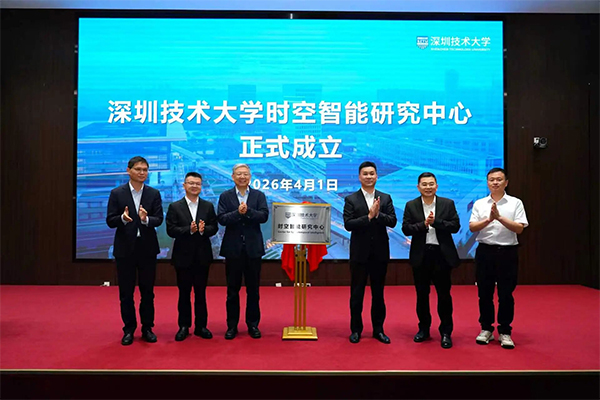
Shenzhen Technology University’s Spatiotemporal Intelligence Research Center is launched on April 1. Photo from the university
Shenzhen Technology University (SZTU), based in Pingshan District, inaugurated its Spatiotemporal Intelligence Research Center on April 1, marking a major step toward integrating spatiotemporal intelligence with artificial intelligence (AI). The center is designed to support national strategic needs and boost Shenzhen’s AI and low-altitude economy.
Spatiotemporal intelligence enables AI to understand and use information about where things are and how they change over time, helping it to analyze movement and predict future outcomes. It is used in transportation, logistics and supply chains, autonomous vehicles, smart cities, and sports and surveillance analytics, among other fields.
The new center will focus on fundamental research, technological breakthroughs, the commercialization of research achievements, and talent development in this fast-growing field. Li Qingquan, an academician of the Chinese Academy of Engineering, serves as the chief scientific advisor to the center. Zhang Lijun, dean of the SZTU School of Artificial Intelligence, is the center’s director. The center operates under a director-responsibility system.
The center includes three research teams: Multi-source Fusion Positioning, Urban Spatiotemporal Intelligence, and Embodied Intelligent Perception. Their work covers the full chain of spatiotemporal data — acquisition, interpretation, and application — with three main research directions: autonomous perception and navigation, urban spatiotemporal intelligence and large models, and embodied spatiotemporal intelligence for autonomous operations.
The center aims to become a provincial key laboratory over the next five years, building a distinctive and influential research platform. According to SZTU officials, the center will promote cross-disciplinary collaboration among computer science, surveying, transportation, logistics, and AI, creating new growth areas for academic research. It also reflects SZTU’s philosophy of “application-oriented academia.”
Li said that the AI era calls for new, more dynamic approaches to traditional surveying and mapping. He emphasized that the center will remain focused on cutting-edge research, real-world needs, and practical applications, strengthening China’s capabilities in spatiotemporal intelligence.

ICP Registration Number: 粤ICP备17054870号-1
 Police Registration Number:44031002000124
Website ID: 4403910001
Police Registration Number:44031002000124
Website ID: 4403910001
Government Service Hotline: 0755-12345
Website Technical Support:zwxx@szpsq.gov.cn
Sponsored by: General Office of CPC Pingshan District Committee (General Office of Pingshan District People's Government, Foreign Affairs Office of Pingshan District, and Archives Administration of Pingshan District)



 HOME
HOME PINGSHAN GOVERNMENT
 NEWS
NEWS ABOUT PINGSHAN
 INVEST IN PINGSHAN
 LIFE
LIFE SERVICES
 FAQ
FAQ CHINESE
 FRANÇAIS
 日本語
日本語 한국어
한국어