 Local News
The main structure of the Shenzhen Natural History Museum in Pingshan District has been completed, and the museum is expected to open in the summer next year. Current work is focused on fitting out the exhibition spaces and collecting artifacts.
Located in the Yanzi Lake area, the site covers about 42,000 square meters of land, with a total floor area of roughly 105,300 square meters. The museum has five above-ground floors and two underground levels. Its planned facilities include six functional zones — exhibitions, public services, education, collection preservation and conservation, operations, and research — along with an underground parking garage and equipment rooms.
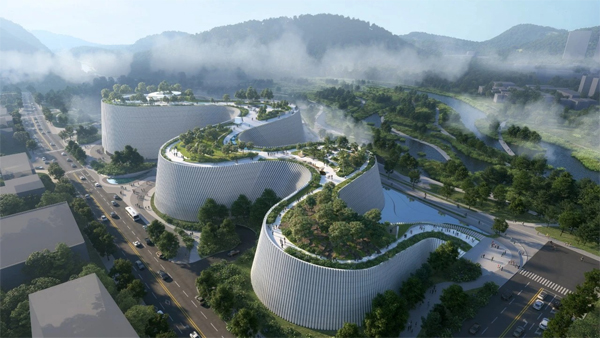
A computer-generated image of the Shenzhen Natural History Museum in Pingshan District.
The museum’s core missions are collecting, exhibiting, researching and providing natural science education. It aims to become a leading center for natural specimen displays and science education in China, and to develop into a world-class hub for natural history collections and scientific research.
Architecturally, the design is grand and dynamic, integrating built form with the natural environment. Centered on a “rivers” theme, the project is conceived as a vibrant new “delta,” weaving the elemental concept of water into its spatial layout and functional design.
As one of Shenzhen’s major cultural projects, the museum will be the first large-scale, comprehensive natural history museum in the Guangdong-Hong Kong-Macao Greater Bay Area and South China when completed.

A computer-generated image of the interior of Shenzhen Natural History Museum.
The museum will feature four permanent exhibition areas — “Discovering Forests,” “Understanding the Ocean,” “Learning About Minerals,” and “Exploring Life” — as well as six thematic halls: Nature·World, Nature·Collection, Nature·Principles, Nature·Dialogue, Nature·Shenzhen, and Nature·Exploration.
The exhibition spaces will total about 20,000 square meters and will present natural art, natural science, natural history, ecology, and conservation through diverse displays and modern technologies, creating a vivid, multidimensional view of the natural world.
The museum will also offer a wide range of educational programs for the public, especially for young people, to foster greater understanding and appreciation of nature.

ICP Registration Number: 粤ICP备17054870号-1
 Police Registration Number:44031002000124
Website ID: 4403910001
Police Registration Number:44031002000124
Website ID: 4403910001
Government Service Hotline: 0755-12345
Website Technical Support:zwxx@szpsq.gov.cn
Sponsored by: General Office of CPC Pingshan District Committee (General Office of Pingshan District People's Government, Foreign Affairs Office of Pingshan District, and Archives Administration of Pingshan District)



 HOME
HOME PINGSHAN GOVERNMENT
 NEWS
NEWS ABOUT PINGSHAN
 INVEST IN PINGSHAN
 LIFE
LIFE SERVICES
 FAQ
FAQ CHINESE
 FRANÇAIS
 日本語
日本語 한국어
한국어