 Local News
The Pingshan New Energy Automobile Industrial Park in Pingshan District has become a focal point for new energy vehicle (NEV) and intelligent connected vehicle (ICV) development, hosting a dense cluster of manufacturers, research institutes, and service providers that together are accelerating Shenzhen’s rise as a new-generation automotive city.
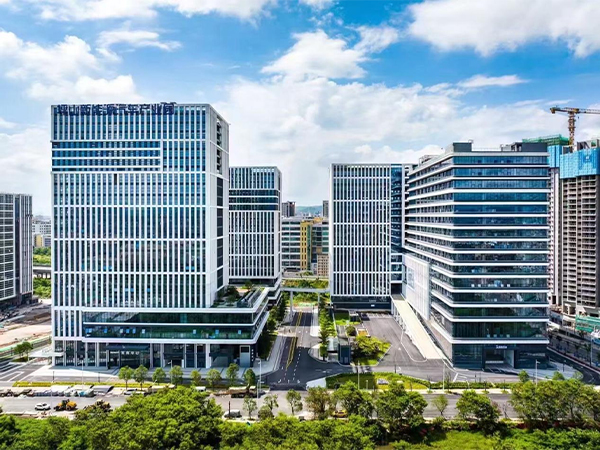
The Pingshan New Energy Automobile Industrial Park in Pingshan District.
The park, designated for NEVs and ICVs, is a key component of Shenzhen’s 20 strategic emerging industrial clusters and eight future industries.
Its high-rise, prefabricated factories were built with an intelligent vertical design to maximize land use and production efficiency. Large trucks can unload directly on the third floor, while smaller vehicles can reach up to the 17th floor via a vertical transport network, the park operator told the press at an open day event Nov. 26.
The park hosts companies across the full automotive value chain — intelligent chassis, new energy storage, automotive-grade chips, in-vehicle systems, autonomous driving, and vehicle-road-cloud integration. “Now, meeting clients or conducting R&D can often be handled just by going upstairs or downstairs, which significantly boosts our efficiency,” a company representative said. “The powerful industrial cluster effect Pingshan District has built provides robust momentum for our development.”
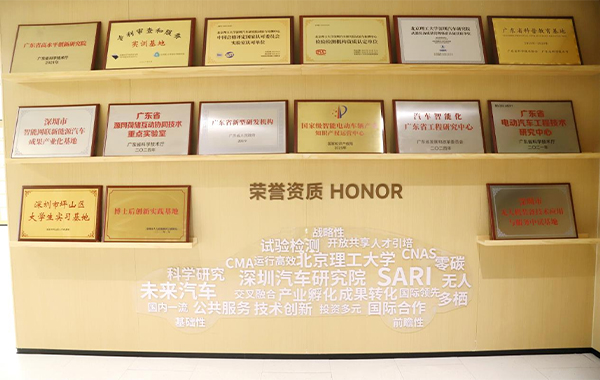
Honorary plaques.
Dozens of high-quality enterprises and research institutions have settled in the park, including the Shenzhen Automotive Research Institute of the Beijing Institute of Technology (BIT), Shenzhen Research Institute of Chang’an University, the Shenzhen Vehicle-Road-Cloud Industry Incubation and Operation Center, Hamedata Technology, Sunwave Sensor, Fudi New Energy Technology, and Anshi New Energy.
Various labs at Shenzhen Automotive Research Institute, BIT enable local SMEs to access pilot-scale facilities and translate R&D outcomes into engineering applications.
The institute was recently recognized as a national-level industrial intellectual property (IP) operation center. Since its establishment, it has filed nearly 300 IP applications, with about 200 granted, covering core areas such as NEV three-electric systems and ICV technologies.
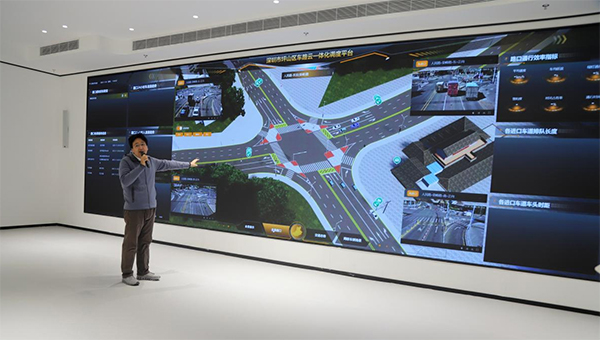
A representative introduces the vehicle-road-cloud integration platform in Pingshan.
“We collaborate with enterprises within the park to build an automotive industry ecosystem, focusing on their R&D and production challenges,” a representative of the institute said. “We provide one-stop solutions that span R&D, testing and verification, product piloting, IP operation and industrial incubation.” The institute said it concentrates on three future vehicle technologies — “zero-carbon, unmanned, and multi-terrain” — while integrating the innovation chain and pooling global resources to build an innovation hub for future vehicles.
Beyond factory space, the park operator, Ping An Operation, provides complementary services including policy consulting, financing access, market promotion, technology commercialization, and legal and HR support to help enterprises reduce costs and speed growth. IoT, big data, and 5G are used for smart management of security, parking, and energy.
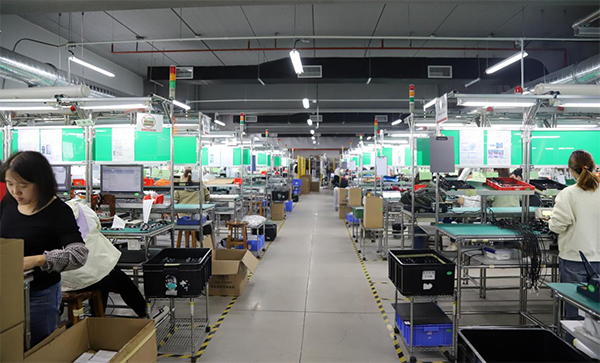
A factory at the Pingshan New Energy Automobile Industrial Park.
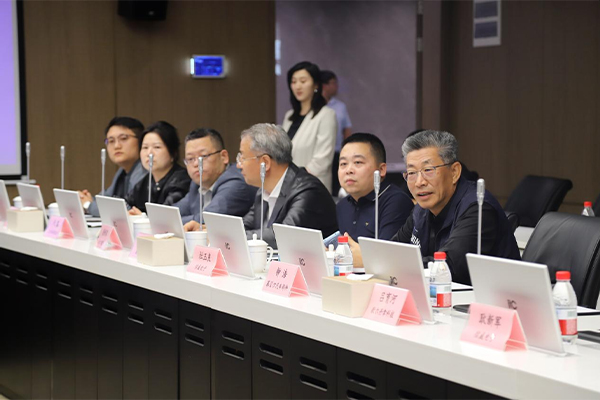
Representatives from research and financial institutions, enterprises, and government departments discuss NEV technology and development on Nov. 26.
“We moved into the industrial park in May 2025,” said a Sunwave Sensor representative. “I am very satisfied with Pingshan’s industrial resources and the park’s operational services. Due to business expansion, I’m planning to lease an additional 3,000 square meters within the park.”
As the core area for Shenzhen’s push to build a world-class automotive hub, Pingshan is home to more than 300 NEV companies, including BYD. The district’s ICV and NEV sectors recorded a combined output of close to 500 billion yuan in 2024, with the ICV sector’s added value accounting for 62% of Shenzhen’s total — an indicator of the area’s industrial concentration and influence.

ICP Registration Number: 粤ICP备17054870号-1
 Police Registration Number:44031002000124
Website ID: 4403910001
Police Registration Number:44031002000124
Website ID: 4403910001
Government Service Hotline: 0755-12345
Website Technical Support:zwxx@szpsq.gov.cn
Sponsored by: General Office of CPC Pingshan District Committee (General Office of Pingshan District People's Government, Foreign Affairs Office of Pingshan District, and Archives Administration of Pingshan District)


 HOME
HOME PINGSHAN GOVERNMENT
 NEWS
NEWS ABOUT PINGSHAN
 INVEST IN PINGSHAN
 LIFE
LIFE SERVICES
 FAQ
FAQ CHINESE
 FRANÇAIS
 日本語
日本語 한국어
한국어