 Schools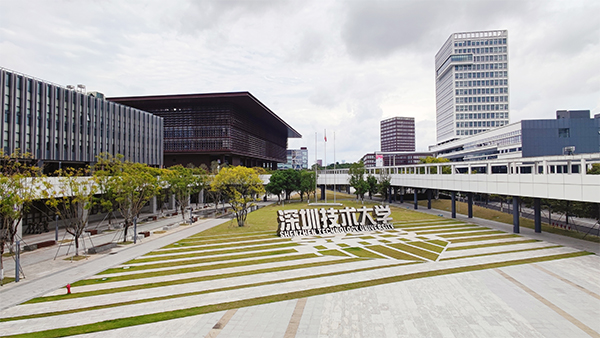
A glance at Shenzhen Technology University in Pingshan District. Photos by Sun Yuchen unless otherwise stated
Shenzhen Technology University (SZTU), located in Pingshan District, is a public institution of higher education, with a total construction area of 1.05 million square meters. It was approved by the Ministry of Education in November 2018.
The university is firmly committed to pioneering a new model of research-oriented education, guided by the philosophy of “Innovation as Foundation, Demand-Driven Development, Open Integration, and Intelligent Leadership.” It closely aligns with national strategic needs and the industrial demands of Shenzhen and the Guangdong-Hong Kong-Macao Greater Bay Area (GBA), striving to build itself into a cradle for innovative engineers and entrepreneurs, as well as a source of industrial technological innovation in the GBA.
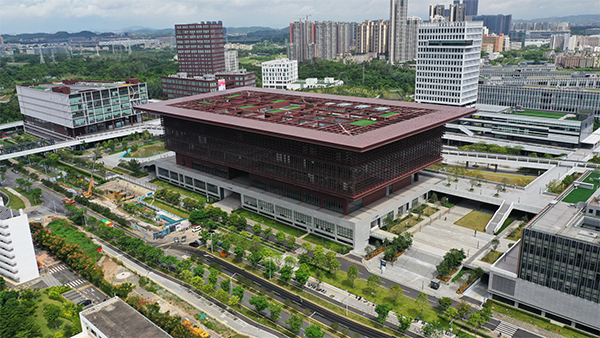
Shenzhen Technology University’s library.
As of August 2025, there are more than 14,500 undergraduate students and over 1,100 master’s and doctoral students. The university employs more than 907 full-time teachers, including four academicians, 127 professors and 240 associate professors. Over 400 faculty members are recognized as high-level talents at or above the municipal level, and 15 of them are listed among the world’s top-2% scientists. Among the full-time faculty, 86% hold doctoral degrees, 60% have overseas study or research experience, and 40% possess corporate R&D backgrounds.
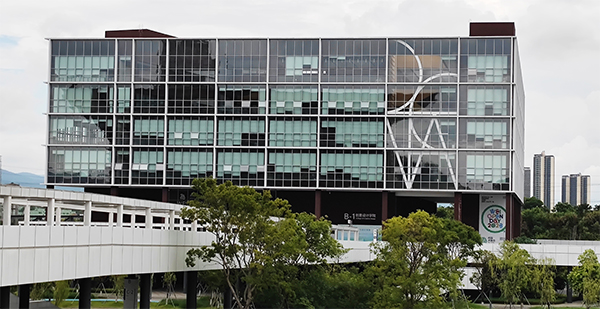
Shenzhen Technology University’s School of Design and Innovation.
The university places strong emphasis on industry-education collaboration, embedding itself in Shenzhen’s “20+8” industrial clusters. It has forged in-depth partnerships with 263 leading enterprises and established six industry colleges, including the Shenzhen Semiconductor Advanced Manufacturing College, the SF Fengxue Industry College, and the BYD Future Mobility College. 17 elite programs have also been launched, such as the Huawei Kunpeng Elite Class, Tencent Security Talent Class, Baidu AI Elite Class, BYD Automotive Industrial Design Elite Class, and Loongson Zhongke Talent Class.
Dedicated to internationalization and open development, SZTU actively promotes global collaboration. It has jointly established seven international joint laboratories with top universities in countries such as Germany and Switzerland. To date, the university has established partnerships with 132 overseas universities and institutions, engaging in extensive international cooperation in faculty and student exchanges, joint training programs, and scientific research.
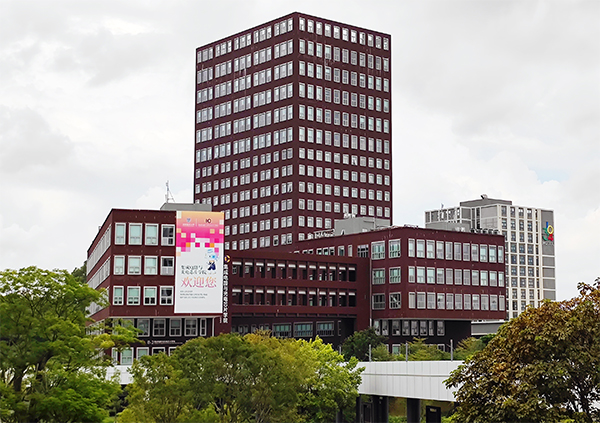
Shenzhen Technology University’s College of Integrated Circuits and Optoelectronic Chips.
SZTU sets up specialties and courses according to the needs of national and local development. The university currently comprises 17 colleges and schools, and offers 40 undergraduate programs to students, covering five disciplines including Engineering, Sciences, Liberal Arts, Management, and Arts.
SZTU is forging a new path in modern engineering education with Chinese characteristics, aiming to contribute intellectual strength and innovation to regional socio-economic development and national technological self-reliance.
Website: https://english.sztu.edu.cn/
Student admission: +86 755 23256666
International Office: +86 755 2325 6620 (E-mail: international@sztu.edu.cn)
Human Resources: +86 755 2325 6280 (hr@sztu.edu.cn)
Add: 3002 Lantian Road, Pingshan District (坪山区兰田路3002号)
Metro: Line 16 to Technology University Station (技术大学站), Exit C or D
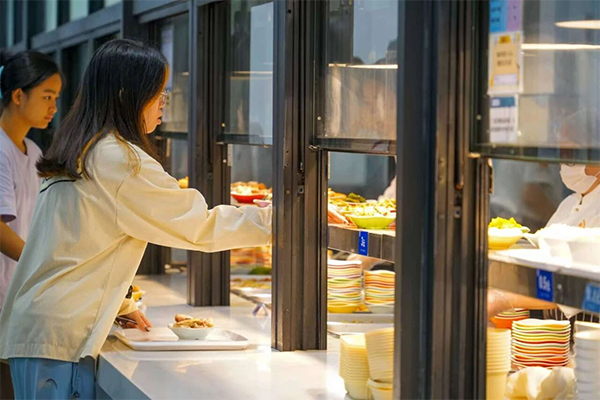
A glance at an SZTU canteen. Photo from SZTU
I don’t work or study at SZTU. Can I use its library and canteens?
Yes. At Shenzhen Technology University (SZTU), you can visit the library and dine at its campus canteens.
Booking is required to enter the library. For first-time reservations, visitors must correctly answer 8 out of 10 questions in Chinese on library etiquette on the online reservation page.
The library is open from Monday to Saturday: 8:30 a.m.-10:30 p.m.; Sunday: 8:30 a.m.-9 p.m. Hours may be adjusted during winter/summer breaks and public holidays. Access may also be temporarily suspended during major campus events or peak exam periods. Floors 2-6 are open to the public, offering in-library reading, seating, and selected cultural activities.
At the canteens, payment can be made via WeChat Pay or Alipay, with an added 30% service charge. Canteens offer a mix of Chinese and Western light meals, Cantonese dishes, bakery items, desserts, and malatang hot pot.
To maintain normal academic and campus order, classrooms, labs, and dormitories are not open for visits.

ICP Registration Number: 粤ICP备17054870号-1
 Police Registration Number:44031002000124
Website ID: 4403910001
Police Registration Number:44031002000124
Website ID: 4403910001
Government Service Hotline: 0755-12345
Website Technical Support:zwxx@szpsq.gov.cn
Sponsored by: General Office of CPC Pingshan District Committee (General Office of Pingshan District People's Government, Foreign Affairs Office of Pingshan District, and Archives Administration of Pingshan District)



 HOME
HOME PINGSHAN GOVERNMENT
 NEWS
NEWS ABOUT PINGSHAN
 INVEST IN PINGSHAN
 LIFE
LIFE SERVICES
 FAQ
FAQ CHINESE
 FRANÇAIS
 日本語
日本語 한국어
한국어